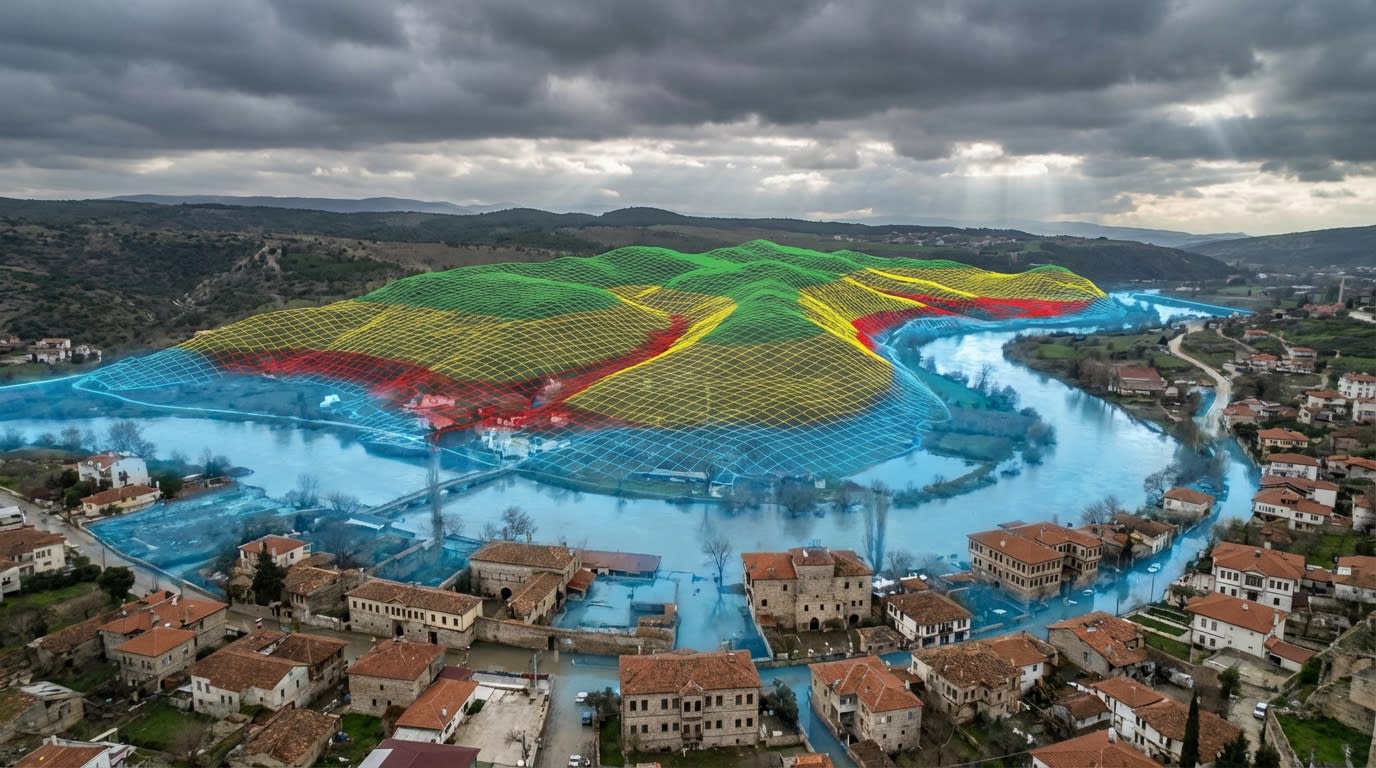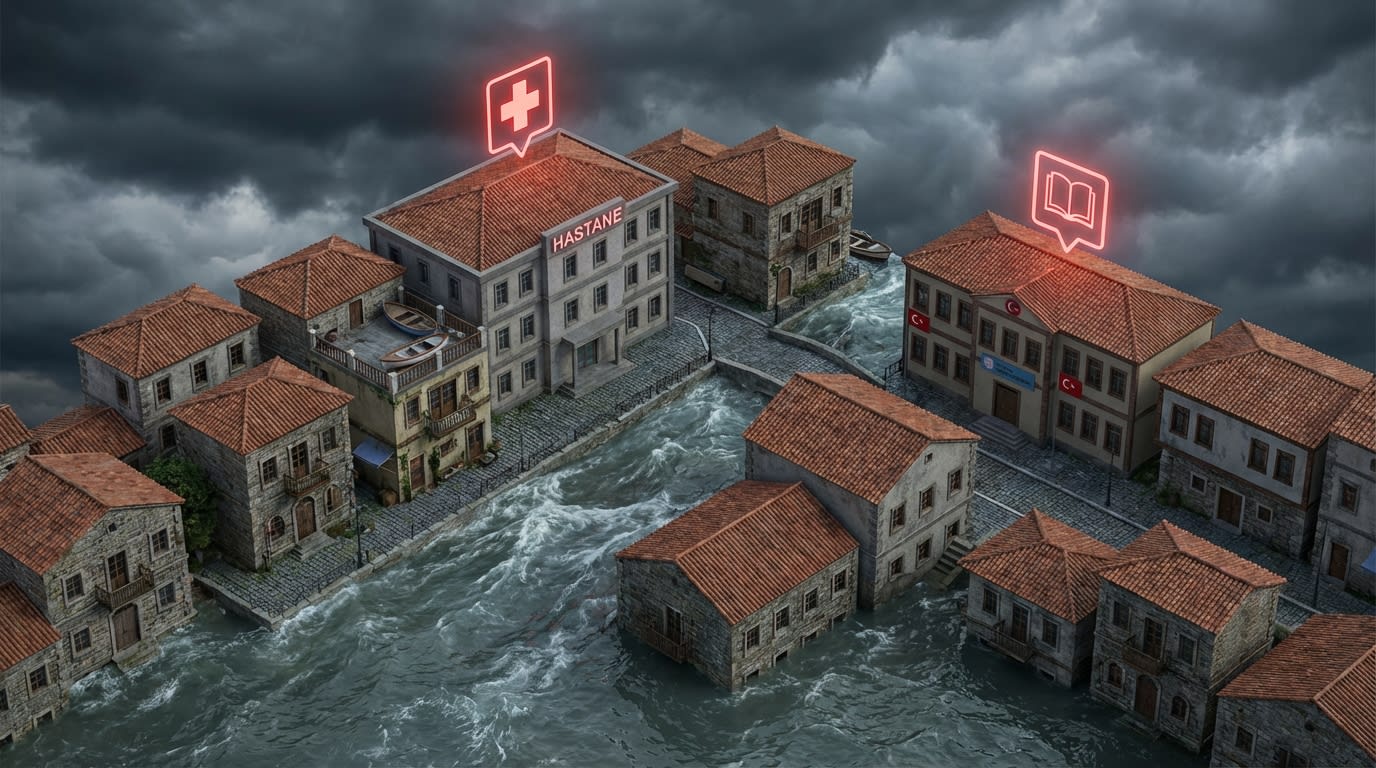
Floods are one of the most frequent natural disasters in Turkey. Yet the disaster itself is only half the problem — being caught unprepared is just as dangerous. Flood simulations model an event digitally in advance, delivering critical decision-support data to municipalities, water agencies and disaster authorities.
In this article we take a detailed look at what flood simulation is, how it is performed and where it is applied.
What is a Flood Simulation?
A flood simulation is a dynamic, time-dependent analysis that models water movement over terrain under a given precipitation scenario. Unlike a static flood map, a simulation shows how water rises over hours, which streets are covered at which times and where the maximum depths occur — step by step.
Simulations use 2D and 3D hydrodynamic models. Especially in urban environments, models that factor the effect of buildings, roads and infrastructure on flow produce realistic results.
Why It Matters
Flood simulations play a critical role at every stage of disaster management:
- Pre-disaster planning: Establishing evacuation routes, selecting assembly points and defining early warning thresholds
- Infrastructure investments: Testing drainage capacity and validating new channel and levee projects via simulation
- Zoning: Restricting construction in risky zones and setting floor limits
- Insurance and risk assessment: Computing regional risk scores
- Public awareness: Making risk tangible through 3D visualizations
Technical Stack
A realistic flood simulation requires the following components:
- High-resolution digital terrain model: LiDAR-based DTM/DSM at a minimum 1-meter grid
- Hydraulic modeling software: tools like HEC-RAS 2D, MIKE FLOOD, TUFLOW or FLO-2D
- Hydrological data: rainfall-runoff models, discharge records and watershed characteristics
- Land-use data: current ground cover for setting Manning roughness coefficients
- Calibration data: trace elevations and water-level records from past floods
The modeling output produces depth, flow velocity and water-surface elevation maps for every time step. These are visualized in GIS and delivered to decision makers.
AFAD and the ARAS Project
The ARAS (Disaster Risk Reduction System) Project run by AFAD aims to produce and maintain up-to-date disaster risk maps across Turkey. Flood risk analyses are part of the project, with standard risk-assessment methodologies being developed for municipalities and provincial directorates.
ARAS integrates satellite imagery, meteorological data and ground measurements into a national-scale disaster risk inventory. Flood simulations are one of its most important components.
What Municipalities Should Do
To take a proactive stance against flood risk, municipalities should:
- Produce up-to-date maps of streams and floodplains within their jurisdiction
- Commission flood simulations for different precipitation scenarios
- Integrate simulation outputs into zoning plans
- Base evacuation plans on simulation data
- Test stormwater infrastructure capacity via simulation
- Publish interactive risk maps for citizens
Metropolitan municipalities in particular should treat flood simulation as a mandatory base input in urban renewal projects.
Verigo's Experience
At Verigo Digital Engineering we have run flood simulations for many municipalities and public institutions. Using digital terrain models produced from high-resolution LiDAR, we performed 2D hydrodynamic modeling to compute flood extents and depths step by step.
By pairing the results with 3D visualizations we helped decision makers see the risk concretely. This data informed everything from evacuation plans to infrastructure investment decisions.
Flood simulation belongs before the disaster — not after. Every scenario modeled digitally is a life saved in the field.