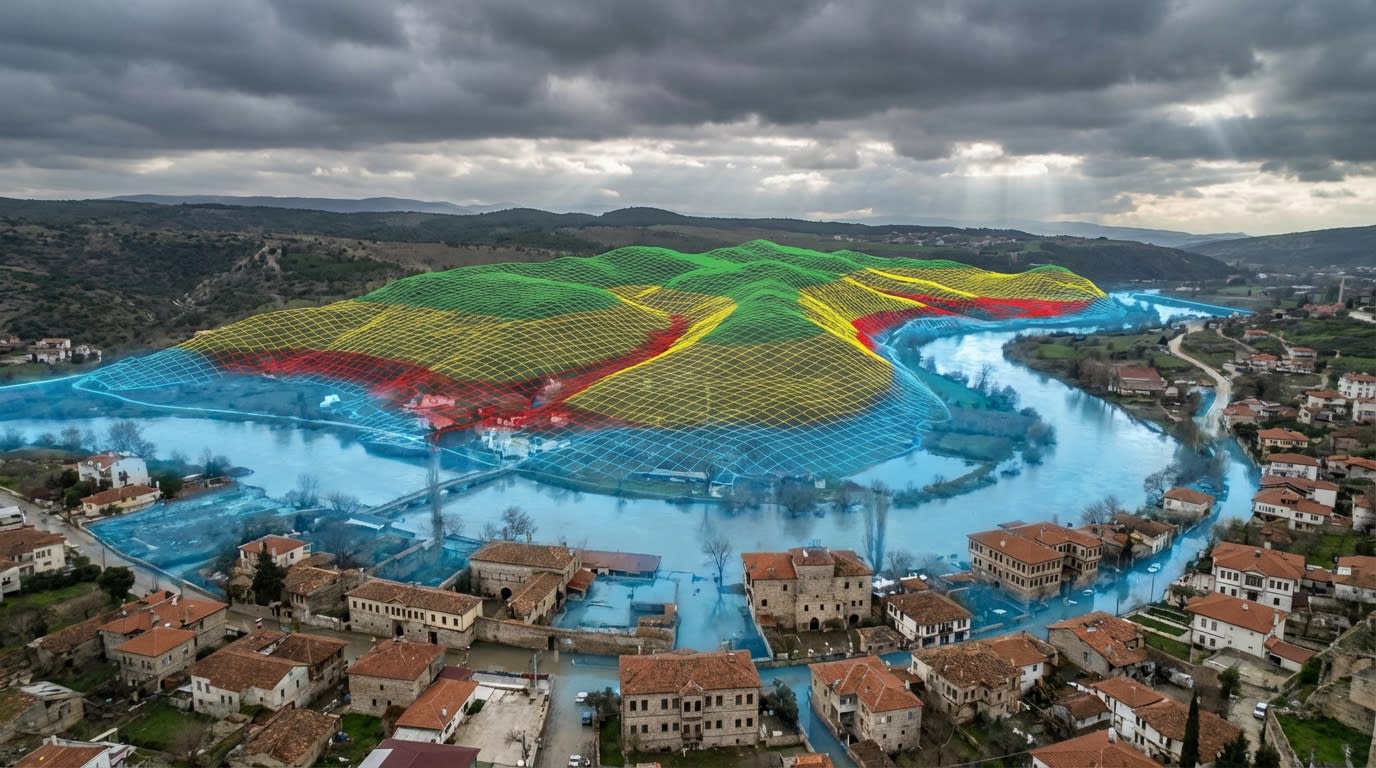
Air pollution is one of the most serious environmental threats worldwide, contributing to millions of premature deaths each year. In Turkey, pollutants such as PM10, PM2.5, SO₂ and NOₓ directly threaten public health — especially in major cities and industrial zones. Traditional air quality monitoring is limited to point measurements, while 3D modeling reveals both the horizontal and vertical distribution of pollution.
Why 3D Modeling is Essential
In Turkey, the Continuous Monitoring Center (SİM) network under the Ministry of Environment, Urbanization and Climate Change measures air quality through hundreds of stations. However, those stations make point measurements — they only capture pollution at their location. The gaps between stations, elevation differences and urban microclimates cannot be understood from that data alone.
3D air quality modeling fills those gaps. By combining emission sources, meteorology and the physical form of the city, it computes pollution distribution in three dimensions. This makes it possible to see — concretely — how pollution differs between a ground-floor street and the 10th floor, how the leeward and windward sides of a park compare, and which neighborhoods are affected by a plant's stack emissions.
Technical Process
3D air quality modeling is a systematic five-step process:
- Emission inventory: Every pollutant source in the project area (industrial stacks, traffic, residential heating, construction) is inventoried with its emission rates and composition. Hourly, daily and seasonal profiles are constructed for each source.
- Meteorological data: Wind speed and direction, temperature, humidity, atmospheric stability class and mixing height are compiled for at least one year. These inputs drive pollutant transport and dispersion behavior.
- 3D city model: A digital surface model (DSM) and building models produced from LiDAR or photogrammetry are used for wind flow and turbulence calculations. Building geometry, street canyons and open areas are critical inputs for model accuracy.
- Dispersion modeling: Dispersion models such as AERMOD (US EPA-approved) or CALPUFF compute pollutant propagation through the atmosphere. These models use Gaussian plume equations and advanced turbulence parameterizations to produce hourly concentration values.
- GIS visualization: Model outputs are visualized in 3D within GIS. Pollution maps are produced at different heights (ground level, 10 m, 25 m, 50 m) and time-series animations reveal daily and seasonal variation.
Legal Framework
In Turkey, air quality management is governed by the Air Quality Assessment and Management Regulation, aligned with EU Air Quality Directives, setting limit values for pollutants including PM10, PM2.5, SO₂, NO₂, CO and O₃.
In the Environmental Impact Assessment (EIA) process, an air quality modeling report is mandatory for new industrial facilities and large infrastructure projects. AERMOD or equivalent dispersion models are used to evaluate the project's impact and demonstrate that limit values will not be exceeded.
In addition, Clean Air Action Plans are prepared for provinces that exceed air quality limits. These plans define measures in transport, industry, heating and urban planning. 3D modeling stands out as a critical tool both for drafting and for tracking the effectiveness of these plans.
Verigo's 3D Air Quality Project
At Verigo Digital Engineering, as part of our 3D Air Quality Project, we run city-scale pollution modeling. We overlay dispersion analysis results onto high-resolution 3D city models produced from LiDAR, visualizing pollution on a floor-by-floor basis.
This approach makes concrete differences visible: the air quality gap between the ground floor and upper floors of a residential development, pollution in a schoolyard, or conditions around a hospital. The outputs serve local governments in zoning decisions, health institutions in risk assessment, and citizens as an awareness tool.
Air pollution may be invisible, but with 3D modeling it becomes measurable and manageable. With the right data and the right model, we can turn our cities into healthier places to live.